You are here

heat stress

Florida Legislators Ban Local Heat Protections for Millions of Outdoor Workers

By Amy Green and Victoria St. Martin - Inside Climate News, March 19, 2024

ORLANDO, Fla.—Even if the often unbearable Florida temperatures started creeping up toward triple digits, Maria Leticia Pineda could usually be found clad in at least three layers of clothing to protect her skin from sunburns while she worked in an outdoor plant nursery.

Pineda spent 20 years working 11-hour days as she helped grow fruits like strawberries, blueberries and pineapples, as well as vegetables, ferns and other plants. But by 2018, between headaches that she believes were exacerbated by the heat, recurring pains in her right elbow and back and aches just about everywhere else, she’d had enough.

“I love agriculture and working with people and the environment, but I stopped because it’s so hot,” said Pineda, who is 51. “With the heat, it won’t kill you right away. I’ve felt the struggle for so long and the damage stays with you.”

The state’s 2 million outdoor workers are poised to have less access to accommodations like water and shady rest breaks under a bill the Florida Legislature recently approved.

The measure prohibits local governments from establishing heat protections for outdoor workers. It comes after commissioners in Miami-Dade County considered a proposal last year that would have compelled construction and agriculture companies to provide water and rest breaks when the heat index there rises to 95 degrees Fahrenheit or higher. The proposal also would have required training in heat illness and first aid, but it was never brought to a vote.

The new state legislation preempts any such local provisions. It was approved earlier this month, on the final day of the annual session, but still requires the signature of Gov. Ron DeSantis, a Republican who has described himself as “not a global warming person.” His climate change policy has focused on fortifying the state’s infrastructure against rising seas and increasingly damaging hurricanes, but he has done little to address the human-caused emissions contributing to hotter temperatures.

Florida GOP Passes 'Vicious' Bill Banning Mandatory Water Breaks for Workers

By Julia Conley - Common Dreams, March 8, 2024

"We will see fatalities, because of what Florida Republicans chose to do this week," said one workers' rights advocate.

Displaying "punitive cruelty" toward Florida residents who work outdoors, the Republican-controlled state House on Friday approved a bill that would ban local governments from requiring that workplaces provide water breaks and other cooling measures.

The state Senate passed the measure on Thursday, with Republicans pushing the bill through as Miami-Dade County was scheduled to vote on local water break protections. If signed into law by the Republican governor, the proposal will preempt the county's vote.

Roughly 2 million workers are expected to be affected by the legislation in Florida, where parts of the state experienced record-breaking heat last year. Meteorologists found that last month was the hottest February ever recorded globally, and the ninth straight month to set such a record.

Miami-Dade County officials estimate that 34 people die from heat-related causes each year.

"Every single year, it's going to get hotter and hotter," Oscar Londoño, executive director of worker advocacy group WeCount!, toldThe Guardian. "Many more workers' lives are going to be at risk. We will see fatalities, because of what Florida Republicans chose to do this week."

Londoño called the bill a "cruel... bad faith attempt to keep labor conditions very low for some of the most vulnerable workers."

Job Quality in the Fields: Improving Farm Work in the US

By Gerardo Reyes Chavez, Daniel Costa, Lloys Frates, Ph.D, Mireya Loza, and Ximena Bustillo - The Aspen Institute, February 28, 2024

Turner heat study finds workers at risk even on ‘cooler’ summer days

By Zachary Phillips - Constructive Dive, January 4, 2024

Dive Brief:

  • A study looking at the effects of working outside in hot weather by New York City-based Turner Construction discovered many workers’ core body temperatures reached risky levels even on moderate summer days.
  • The heat pilot study, conducted over three days last summer with an average peak temperature of 88 degrees Fahrenheit, found that 43% of the 33 workers monitored had core temperatures reach over 100.4 F, even in “cooler than typical summer conditions.” OSHA lists 100.4 F as the benchmark for an elevated risk of heat stress.
  • In partnership with the University of New Mexico, Indiana University and La Isla Network — an Alpharetta, Georgia-based organization researching the effects of heat on workers — the study was designed to better understand how increased temperatures affect jobsite safety.

What’s Next for the Teamsters?

Heat Waves and Wildcat Strikes

By Jeff Shantz - LibCom, January 4, 2024

Green syndicalism puts the connectedness of ecological crises and crises of working-class life at the center of analysis—as outcomes of capitalism. It emphasizes ways in which exploitation of labor and the exploitation of nature go hand in hand and develop together. It also centers the importance of working-class resistance in ending the capitalist social system that causes, and thrives on, both.
Climate crises, which have moved beyond crisis to pose an existential threat to numerous life forms on the planet, disproportionately impact the working class—especially the poorest, most precarious, racialized sectors of the working class globally. Appropriately, heat waves have become a focus of labor action in a range of industries.

According to data from the US Bureau of Labor Statistics, 53 workers died in the US due to temperature extremes in 2019, and the climate crisis is creating more, and new, hazardous conditions for workers, as heat waves, heat domes, and extreme heat become more regular and extensive. Between 1992 and 2017, heat stress killed 815 US workers while seriously injuring more than 70,000. Extreme heat kills more people each year than floods, hurricanes, and tornadoes, all of which are also becoming more frequent, in the US, according to the National Weather Service. On the whole, about 700 people die from heat-related illnesses each year. And the situation is only getting worse.

The number of “hot days” recorded in the United States has been increasing over decades. The 2018 National Climate Assessment, a major scientific report by 13 federal agencies, found that the frequency of heat waves increased from an average of two per year in the 1960s to six per year by the 2010s. It is not only the frequency of heat waves that is increasing, but the duration of each heat wave. The National Climate Assessment concluded that the season for heat waves is now a full 45 days longer than it was in the 1960s.

The impacts of capitalist climate crises, which disproportionately harm working class people, impel new strategies and tactics for working class organizing, as well as novel deployments of tried-and-true actions—such as wildcat strikes. Notably, we are seeing a revival of walkouts and wildcats against unsafe and unhealthy working conditions in the context of heat waves and heat domes, especially as these become more intense and more frequent.

Barry Eidlin & Paul Prescod on Labor’s Moment Today

Dying in the Fields as Temperatures Soar

By Liza Gross and Peter Aldhous - Inside Climate News, December 31, 2023

Scores of California farmworkers are dying in the heat in regions with chronically bad air, even in a state with one of the toughest heat standards in the nation.

For most of July 2019, stifling heat hung over the agricultural fields of California’s Central Valley, as farmworkers like William Salas Jiminez labored under the sun’s searing rays. Temperatures had dipped from 99 to 95 degrees Fahrenheit the last day of the month, when the 56-year-old Puerto Rico native was installing irrigation tubing in an almond orchard near Arvin, at the valley’s southern edge. 

Around 1:30 that afternoon Salas sat down to rest. When he stood up to go back to work, he suddenly collapsed. An hour and a half later, he was dead. Reports filed with the U.S. Department of Occupational Health and Safety, or OSHA, say Salas died of a heart attack.

Salas’ death certificate lists atherosclerotic heart disease as the immediate cause of death. But it also lists “extreme heat exposure” and obesity as significant contributors. Both heart disease and obesity increase the risk of fatal heatstroke.

An Electrician’s Dispatch: Solidarity at 90 Feet

By Jeff Marshall - Labor Notes, December 15, 2023

Last summer I was working at the Boeing factory in Everett, Washington, on a four-man electrical crew, replacing the existing lights with new LEDs. Our work area was 90 feet off the ground, maybe 20 feet below the roof decking, with no air circulation. You could feel the heat radiating from the ceiling pan.

Our crew has safety discussions every morning. Back in May we had discussed Washington’s heat laws—exposed workers are entitled to water and, if the temperature goes above 90 degrees, an additional rest break.

As the summer heated up, one of our crew members brought in a digital thermometer to check the actual temperature where we were working, not just the weather app. We paraded it by the foreman, as if to say, “We’re keeping a close eye on the situation.”

All summer we never crossed the 90-degree mark, though we came within two degrees. Still, one day a crew member reached his own limits. He notified the foreman and was allowed to come down and take a break, then redirected to a task in a milder climate.

Our time up there is very valuable—management has to coordinate with Boeing day by day for access to the “crane space” above the factory floor. Credit to our foreman: he toed the line on our behalf, prioritizing safety over production.

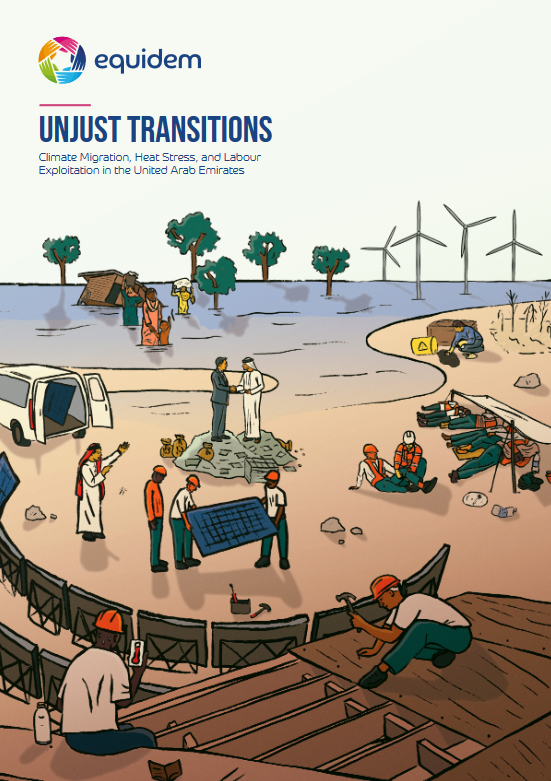
Unjust Transitions: Climate Migration, Heat Stress, and Labour Exploitation in the United Arab Emirates

By staff - Equidem, November 20, 2023

Workers at the heart of the United Arab Emirates's renewable and gig sectors, and at the site that will host the UN Climate Change Conference (COP28) have left homes in Africa and Asia because of climate change only to be subjected to physical abuse, heat stress, exploitation and discrimination, a new report from Equidem reveals. Serious labour violations have taken place at the site of COP28, Expo City, as well as at five renewable energy firms, including Siemens Energy. 

Based on correspondence with 248 workers, and interviews with 102, the expansive report offers unprecedented insight into the renewables, construction, security, and delivery sectors in the UAE, shedding light on both industrial and service sector working conditions for 9 million migrant workers. 

The shining facilities at Expo City Dubai boast internationally lauded solar and wind parks and a booming local gig economy. Underneath that cheerful exterior, however, women and men from some of the poorest countries on earth are falling victim to an unjust transition: Migrant workers from Africa and Asia are being subjected to serious human rights abuses in a nation whose oil and gas-powered economy is at the heart of the planet’s climate crisis. 

“Hosting this peak global conference in a climate and rights abusing state was bad enough. Equidem’s research starkly reveals that the UAE is failing on almost every metric of the UN’s own human rights benchmarks for addressing climate change through the COP process,” said Mustafa Qadri, CEO of Equidem. 

Abuses include workplace violence, wage theft, working in extreme heat and other occupational health and safety risks, nationality-based discrimination, exploitative hiring practices, understaffing and overwork, lack of opportunities for promotion, overcrowded accommodations, inadequate food allowances, and inadequate channels for workers to seek relief from these violations. 

Investigations by Equidem were carried out between February and October 2023 at Expo City Dubai and in the renewables and delivery sectors, including at Mohammed bin Rashid Al Maktoum Solar Park, Al Dhafra Solar Power Project, Noor Abu Dhabi Solar Plant, Sir Bani Yas Wind Farm Project; and in the delivery sector in the UAE. 

  • Together, 57% of the migrant workers interviewed come from climate impacted areas of Asia and Africa.
  • 41 % of the workers reported nationality-based discrimination.
  • 77.% of the workers in renewable sector reported living in overcrowded accommodations, with up to 20 people in a room fit for six or fewer workers.
  • 83% of the African and Asian workers interviewed reported being unable to afford nutritious and healthy food.
  • 40% of the workers said they were skipping meals.

Equidem’s research found that African and Asian workers have migrated for employment based upon climate impacts in their own country, and then find employment in the industrial and service sectors in the UAE. These migrant workers are doubly impacted by the global climate crisis—they migrate in response to climate impacts and find employment in exploitative industrial and service contexts where they work long hours in extreme heat. These rights violations take place against a backdrop of racially delineated exclusion from labour rights protections, denial of freedom of association, and authoritarian suppression of dissent in the UAE. 

Download a copy of this publication here (Link).

Pages

The Fine Print I:

Disclaimer: The views expressed on this site are not the official position of the IWW (or even the IWW’s EUC) unless otherwise indicated and do not necessarily represent the views of anyone but the author’s, nor should it be assumed that any of these authors automatically support the IWW or endorse any of its positions.

Further: the inclusion of a link on our site (other than the link to the main IWW site) does not imply endorsement by or an alliance with the IWW. These sites have been chosen by our members due to their perceived relevance to the IWW EUC and are included here for informational purposes only. If you have any suggestions or comments on any of the links included (or not included) above, please contact us.

The Fine Print II:

Fair Use Notice: The material on this site is provided for educational and informational purposes. It may contain copyrighted material the use of which has not always been specifically authorized by the copyright owner. It is being made available in an effort to advance the understanding of scientific, environmental, economic, social justice and human rights issues etc.

It is believed that this constitutes a 'fair use' of any such copyrighted material as provided for in section 107 of the US Copyright Law. In accordance with Title 17 U.S.C. Section 107, the material on this site is distributed without profit to those who have an interest in using the included information for research and educational purposes. If you wish to use copyrighted material from this site for purposes of your own that go beyond 'fair use', you must obtain permission from the copyright owner. The information on this site does not constitute legal or technical advice.