You are here
Alliance of Nurses for Healthy Environments


Catastrophic Climates and Consequences: A Dive into the Museum of Unnatural Disasters
“Remember normal?” This is a question that resonates with many, especially those who’ve lost homes or been misplaced due to climate-related extreme weather disasters. The Museum of Unnatural Disasters pop-up exhibit, a project of the Climate Action Campaign in partnership with the Center for American Progress, Climate Power, and Extreme Weather Survivors, shares stories from families across the United States whose homes were ravaged by extreme weather events. The exhibit highlights a common recurring motif as a reason for worsening disasters, and one that environmental health researchers and scientists have been warning people about for years: Climate change is making extreme weather worse, leading to more damaging and costly disasters.
The Museum of Unnatural Disasters opened in Constitution Gardens on the National Mall from June 3rd-10th, 2026. Images on display in the pop-up museum paint a picture that people across the country are all too familiar with: the emotional and deadly toll that extreme weather events have on communities. The exhibit showcases items collected from individuals in communities ravaged by climate-related disasters, many weathered and torn apart, including street signs, asthma inhalers, and clothing pieces. Whether it be fatal flash floods in central Kansas, harrowing hurricanes on the Florida coast, or withering wildfires across California and Northern Michigan, these show the human toll that headlines often miss.
Pictured: Children’s artwork and notes after Hurricane Sandy in New Jersey.The name of the pop-up exhibit, The Museum of Unnatural Disasters, calls attention to natural disasters and their unnatural causes. As climate change worsens year by year through global warming and extreme weather events, it’s becoming more stark the impact that fossil fuel emissions have on our deteriorating environment. According to the United Nations, fossil fuel emissions account for 68 percent of greenhouse gas emissions and 90 percent of carbon dioxide emissions, directly contributing to a warming planet and worsening extreme weather patterns.
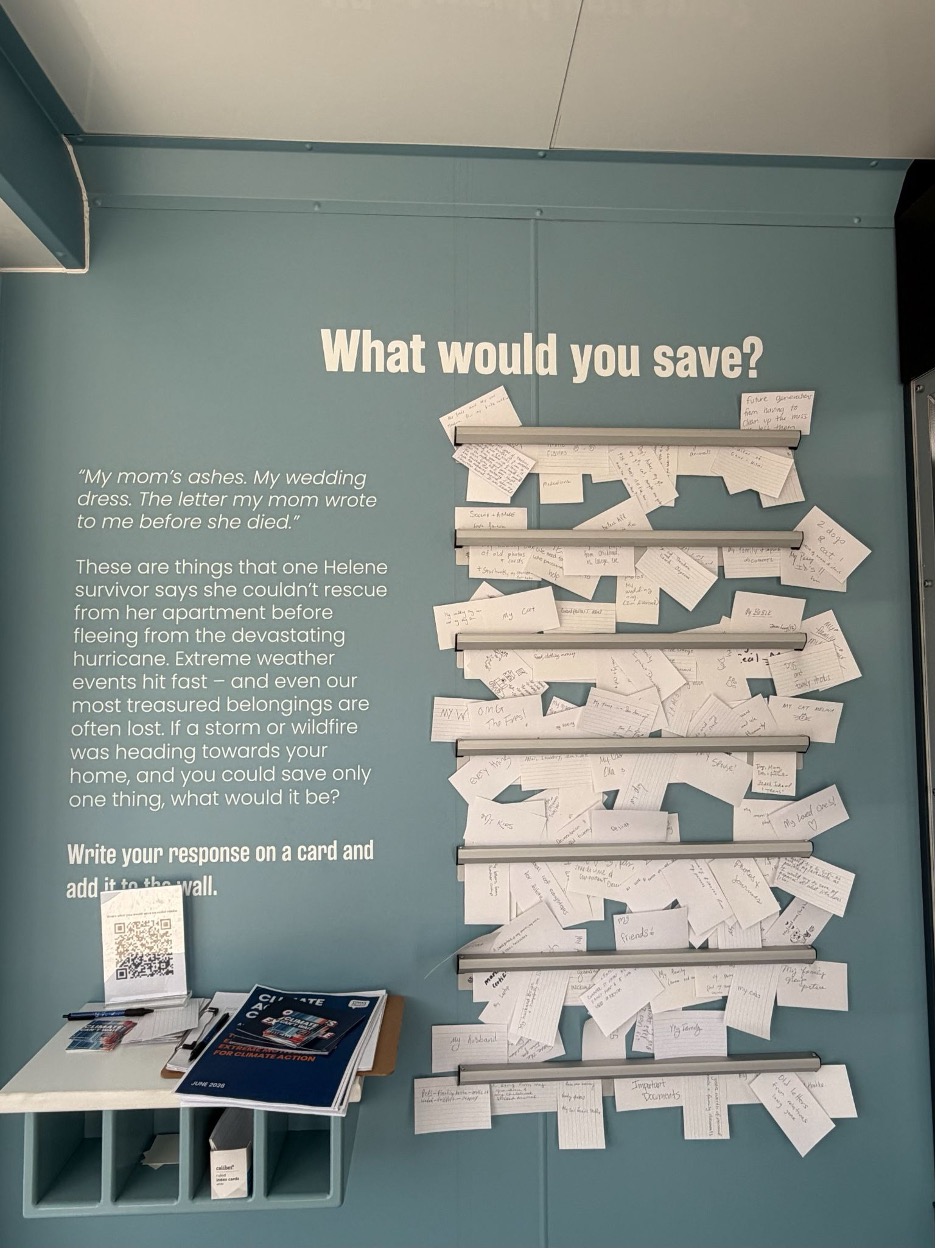
At the end of the exhibit, museum guests were urged to reflect on one thing they would save if a disaster hit their home today. Many responses included pets, family photo albums, or people in the home with them. To have to even reflect on such a tragic question underscores the unfortunate reality of how every region within the United States and the world is at risk.
Pictured: Wall at end of exhibit asking guests to take a card and answer one question: What would you save in the event of a natural disaster?The Museum of Unnatural Disasters inspired museum guests to take action for a better climate. A main goal of the exhibit was to bring attention to and urge action against practices that actively harm our environment, such as continued burning of fossil fuels for energy. One action that can be taken right now is signing on to a petition to members of Congress, demanding they take urgent action to address climate change. Sign the petition here.
Author: Lauren Baldwin is a junior at the University of Central Florida majoring in Health Sciences, and is an Environmental Health undergraduate intern at ANHE.
The post Catastrophic Climates and Consequences: A Dive into the Museum of Unnatural Disasters appeared first on ANHE.
Nurses Oppose EPA’s Proposal to Ease Heavy-Duty Truck Emissions Rules
July 9, 2026
FOR IMMEDIATE RELEASE
Contact
Milagros R. Elia
Program Manager, Climate and Clean Energy Advocacy
Alliance of Nurses for Healthy Environments
milagros@envirn.org
914.455.1165
Nurses Oppose EPA’s Proposal to Ease Heavy-Duty Truck Emissions Rules
(Washington, D.C.) Today, July 9th 2026, the Environmental Protection Agency (EPA) released proposed revisions to the compliance regulations related to Model Year (MY) 2027 and later heavy-duty highway engines.
The EPA has emphasized today’s proposal aims to save the trucking industry an estimated $12 billion by scaling back extended warranty mandates, delaying useful-life requirements, and allowing temporary non-conformance penalties. They did not provide an analysis for how the increased emissions with this proposed rule could impact health.
In response to the proposal, the Alliance of Nurses for Healthy Environments Executive Director Katie Huffling, DNP, RN, CNM, FAAN issued the following statement:
“Nurses are strongly opposed to today’s U.S. Environmental Protection Agency’s proposal to relax air pollution standards for buses and trucks. We witness every day how air pollution affects the health of our patients and communities,”
“Transportation remains one of the largest sources of air pollution in the United States. Nitrogen oxides, particularly nitrogen dioxide, are released into the air due to emissions from vehicles.
Over time, chronic exposure to elevated concentrations of NO2 may contribute to the development of asthma and potentially increase susceptibility to respiratory infections. People with asthma, as well as children and the elderly are generally at greater risk for the health effects of NO2.
With this in mind,we demand policymakers uphold science-based environmental protections that safeguard public health and prioritize policies that protect the health of communities already disproportionately affected by pollution.”
###
The Alliance of Nurses for Healthy Environments is the only national nursing organization dedicated exclusively to the intersection of health and the environment. The Alliance promotes healthy people and healthy environments by educating and leading the nursing profession, advancing research, incorporating evidence-based practice, and influencing public policy.
The post Nurses Oppose EPA’s Proposal to Ease Heavy-Duty Truck Emissions Rules appeared first on ANHE.
How One State Can Impact the Nation
The post How One State Can Impact the Nation appeared first on ANHE.
Press Release! Young people and people of color pay the price when cleanup is delayed
FOR IMMEDIATE RELEASE
June 30th, 2026
CONTACT:
Katie Valentine, kvalentine@cacampaign.org, (770) 861-0397
Mia McPherson, mia@envirn.org, (734) 489-4357
Young people and people of color pay the price when cleanup is delayed
Detroit is not expendable: Federal Coal Ash Rollbacks Threaten Cleanup of Toxic Waste
Please see a recording of the press conference here.
Detroit, Michigan —On Tuesday, June 30, 2026, community leaders, public health experts, and environmental justice advocates discussed the EPA’s delays in the cleanup of coal ash in the Detroit/Wayne County area. The press conference highlighted what is at stake for local communities and the harm caused across the country.
Michigan Senator Stephanie Chang said: “Coal ash is a dangerous substance, a mix of pollutants, metals, carcinogens, including arsenic, boron, cobalt, chromium, lead, lithium, radium, and other heavy metals. And so what does that combination of pollutants mean? It means that people exposed to coal ash, either through their well water or air pollution or contact with contaminated soil, can get cancer, heart disease or other serious conditions. The Trump administration is trying to roll back EPA coal ash rules, and that is dangerous for public health and dangerous for our communities. Old unlined coal-ash sites are leaking hazardous materials into our groundwater and into our lakes and rivers. Here in the Great Lakes state and especially here in Detroit, where we are connected to our beloved Detroit River, we know that we cannot afford to go back.
Nick Leonard, Executive Director, Great Lakes Environmental Law Center, said: “Detroiters are struggling with high levels of air pollution. High levels of ozone pollution, high levels of fine particulate matter pollution, leading it to being named the asthma capital of the United States. And the Detroit River is still recovering from decades of overpollution, notably from the coal industry, that discharged dangerous chemicals into our water for decades without regulation. And now the coal industry is coming to the Trump EPA and saying we can’t afford to clean up our own mess. But Detroiters shouldn’t bear the burden of the coal industry refusing to take accountability for its pollution.”
Dr. Michael Simon, Retired Oncologist, Michigan Clinicians for Climate Action, said:
“As a physician, I am particularly concerned about the health impact of the proposed federal coal Ash rollback. I spent 35 years of my career in Detroit, treating and managing patients with cancer and other illnesses, many of which were either caused by or worsened by toxins associated with coal ash. It is a well-known fact that coal ash contains a litany of toxic chemicals and heavy metals, linked to various cancers, heart disease, thyroid disease, respiratory illness, neurological damage, and other serious health problems. Coal plants in the U.S. produce roughly 70 million tons of coal ash every year that end up in unlined ponds, landfills, and mines. Michigan has at least 18 coal ash ponds. And according to an analysis from Earthjustice, across the country, groundwater is polluted above federal standards at 91% of the plants. You don’t have to look too far to see the Belle River coal power plant sitting right outside Detroit. It is well documented that people living near coal power plants face higher rates of hospitalization, chronic lung disease, and premature deaths. Yes, that is death. Pregnant women are more likely to experience adverse birth outcomes, such as low birth weight. And research suggests that exposure to coal ash can harm our children’s cognitive development. That is our children, our grandchildren, everyone’s children.”
Ken Whittaker, Executive Director, Michigan United, said:
“The Trump EPA wants to erase the coal ash protections communities organized for in 2015 and 2024. Those rules are what forced power companies to monitor groundwater and clean up toxic ash that they left behind. Now this administration wants to undo those protections, not because the science changed, but because corporations ask them to.
“ But they don’t want to tell you about Belle River. Belle River is DTE’s coal plant in China Township, which is converting from coal to gas. And they want you to believe that that solves the problem, but it doesn’t. Because the coal ash remains on the site. In 2023, the EPA reviewed how DTE was storing coal ash and unlined ponds at Bell River and the Monroe plant on Lake Erie. At both sites, they found DTE’s groundwater protection to be inadequate. This rollback makes it harder for the EPA to hold companies like DTE Energy and consumers’ energy accountable when they fail to protect our water.”
These delays will only lead to more health problems for people of color and young people going forward in Detroit and across Michigan. We need the federal government to step up, not back down to these polluters.
###
About Alliance of Nurses for Healthy Environments:
Alliance of Nurses for Healthy Environments (ANHE) supports nurses in promoting planetary health and equity globally by educating and leading the nursing profession, advancing research, incorporating planet-safe practices, and influencing policy.
The post Press Release! Young people and people of color pay the price when cleanup is delayed appeared first on ANHE.
The Fine Print I:
Disclaimer: The views expressed on this site are not the official position of the IWW (or even the IWW’s EUC) unless otherwise indicated and do not necessarily represent the views of anyone but the author’s, nor should it be assumed that any of these authors automatically support the IWW or endorse any of its positions.
Further: the inclusion of a link on our site (other than the link to the main IWW site) does not imply endorsement by or an alliance with the IWW. These sites have been chosen by our members due to their perceived relevance to the IWW EUC and are included here for informational purposes only. If you have any suggestions or comments on any of the links included (or not included) above, please contact us.
The Fine Print II:
Fair Use Notice: The material on this site is provided for educational and informational purposes. It may contain copyrighted material the use of which has not always been specifically authorized by the copyright owner. It is being made available in an effort to advance the understanding of scientific, environmental, economic, social justice and human rights issues etc.
It is believed that this constitutes a 'fair use' of any such copyrighted material as provided for in section 107 of the US Copyright Law. In accordance with Title 17 U.S.C. Section 107, the material on this site is distributed without profit to those who have an interest in using the included information for research and educational purposes. If you wish to use copyrighted material from this site for purposes of your own that go beyond 'fair use', you must obtain permission from the copyright owner. The information on this site does not constitute legal or technical advice.
 This site is not the official webpage of the Industrial Workers of the World.