You are here
A2. Green Unionism
Catastrophic Climates and Consequences: A Dive into the Museum of Unnatural Disasters
“Remember normal?” This is a question that resonates with many, especially those who’ve lost homes or been misplaced due to climate-related extreme weather disasters. The Museum of Unnatural Disasters pop-up exhibit, a project of the Climate Action Campaign in partnership with the Center for American Progress, Climate Power, and Extreme Weather Survivors, shares stories from families across the United States whose homes were ravaged by extreme weather events. The exhibit highlights a common recurring motif as a reason for worsening disasters, and one that environmental health researchers and scientists have been warning people about for years: Climate change is making extreme weather worse, leading to more damaging and costly disasters.
The Museum of Unnatural Disasters opened in Constitution Gardens on the National Mall from June 3rd-10th, 2026. Images on display in the pop-up museum paint a picture that people across the country are all too familiar with: the emotional and deadly toll that extreme weather events have on communities. The exhibit showcases items collected from individuals in communities ravaged by climate-related disasters, many weathered and torn apart, including street signs, asthma inhalers, and clothing pieces. Whether it be fatal flash floods in central Kansas, harrowing hurricanes on the Florida coast, or withering wildfires across California and Northern Michigan, these show the human toll that headlines often miss.
Pictured: Children’s artwork and notes after Hurricane Sandy in New Jersey.The name of the pop-up exhibit, The Museum of Unnatural Disasters, calls attention to natural disasters and their unnatural causes. As climate change worsens year by year through global warming and extreme weather events, it’s becoming more stark the impact that fossil fuel emissions have on our deteriorating environment. According to the United Nations, fossil fuel emissions account for 68 percent of greenhouse gas emissions and 90 percent of carbon dioxide emissions, directly contributing to a warming planet and worsening extreme weather patterns.
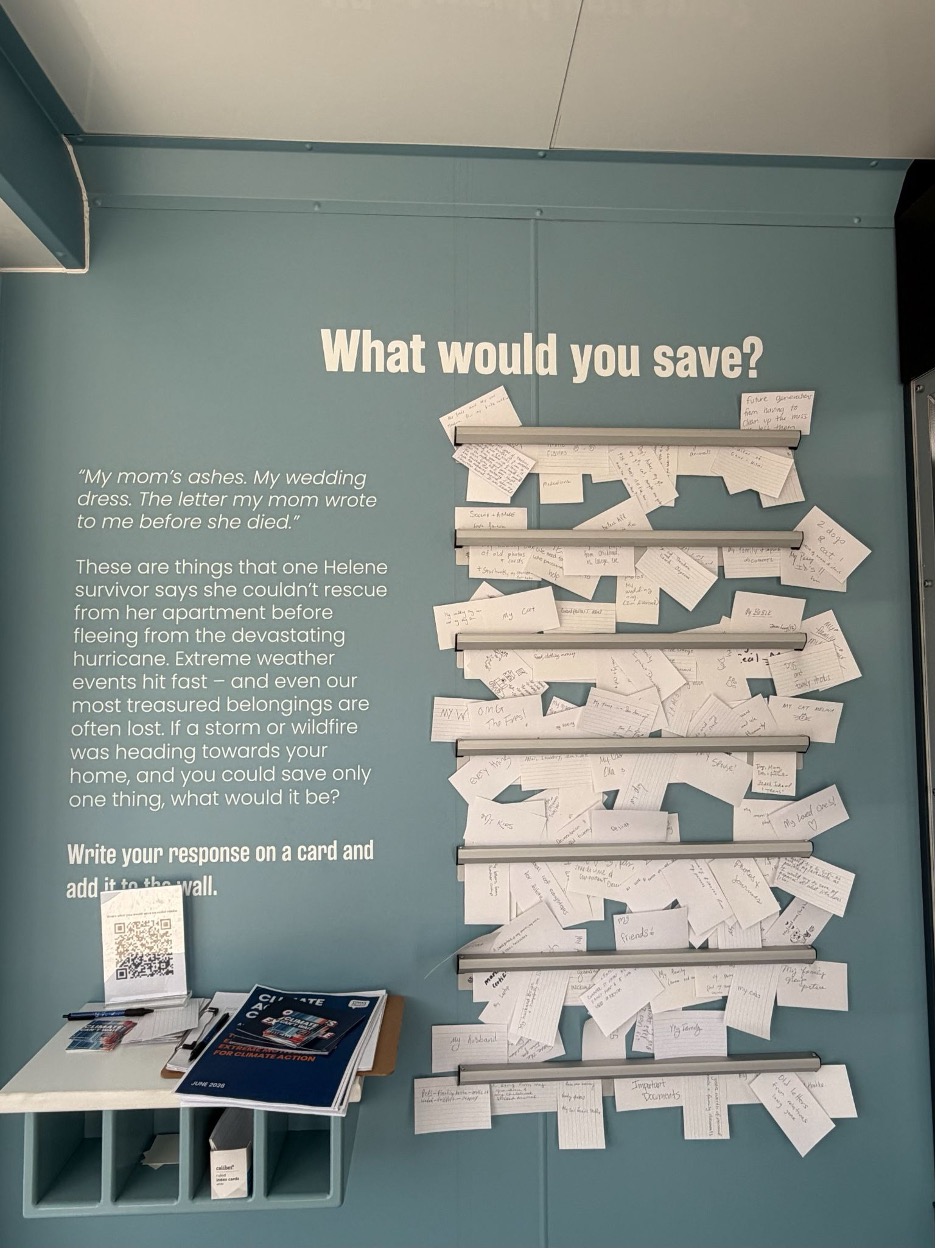
At the end of the exhibit, museum guests were urged to reflect on one thing they would save if a disaster hit their home today. Many responses included pets, family photo albums, or people in the home with them. To have to even reflect on such a tragic question underscores the unfortunate reality of how every region within the United States and the world is at risk.
Pictured: Wall at end of exhibit asking guests to take a card and answer one question: What would you save in the event of a natural disaster?The Museum of Unnatural Disasters inspired museum guests to take action for a better climate. A main goal of the exhibit was to bring attention to and urge action against practices that actively harm our environment, such as continued burning of fossil fuels for energy. One action that can be taken right now is signing on to a petition to members of Congress, demanding they take urgent action to address climate change. Sign the petition here.
Author: Lauren Baldwin is a junior at the University of Central Florida majoring in Health Sciences, and is an Environmental Health undergraduate intern at ANHE.
The post Catastrophic Climates and Consequences: A Dive into the Museum of Unnatural Disasters appeared first on ANHE.
New protection against heat. New opportunity to grow Fair Food.
Every summer, extreme heat threatens the lives and health of the people who harvest our food. But the risks farmworkers face don’t disappear when temperatures cool. Long days of physically demanding work continue to strain the body throughout the year, in soaring temperatures and on cooler days alike.
That’s why, beginning August 1 of this year, every Fair Food Program participating grower will be required to provide electrolyte beverages or electrolyte supplements to workers year-round, further strengthening the Program’s industry-leading heat protections.
The new standard builds on what The Washington Post called “America’s strongest workplace heat rules,” and what Reuters just singled out as a successful cross-sector initiative amidst ever-rising temperatures. Workers on Fair Food Program farms already have what so many are fighting for: shade, clean drinking water, paid rest breaks, heat illness training, and the right to seek medical attention without fear of retaliation. Now, they will also have year-round access to electrolytes—an increasingly important safeguard as scientific research links prolonged heat exposure to chronic kidney disease and other serious health conditions.
This is how the Fair Food Program has always advanced over its 16 years in operation: Workers and growers identify problems, they collaborate on solutions, and together they raise the standards for an entire industry. For going on two decades now, that partnership has transformed agriculture time and time again, be it with the development of groundbreaking field truck safety standards or the carving out of a clean channel for H-2A worker recruitment. Today, tens of thousands of farmworkers across 22 states and three countries are protected by a worker-driven system of education, independent monitoring, rigorous audits, and legally binding market enforcement that has effectively eliminated forced labor, sexual violence, and other severe abuses from participating farms.
And the impact of that pioneering worker-driven approach is expanding every single day.
Worker organizations in industries ranging from construction to sugarcane, bananas, and the plant nursery industry are partnering with the Coalition of Immokalee Workers to bring the Worker-driven Social Responsibility model to millions more workers across the country and around the globe.
That growth depends on people like you.
Every new protection the Fair Food Program wins—and every new industry where workers, suppliers, and corporate buyers plant the flag of this proven model—requires sustained support from people like you, people who believe a world without exploitation and abuse behind every product we consume is possible.
That’s why we’re asking you to become a Fair Food Sustainer today.Your monthly gift provides the reliable support that allows workers to organize, educate their coworkers, strengthen protections like this new electrolyte standard, and bring the Fair Food Program to new industries and countries. One-time donations make a difference. Monthly giving builds movements.
Now is the time to bring that model to millions more workers… but we can’t do it without you.
How hot is too hot?
How hot is too hot?
Photo by Rajiv Bajaj on Unsplash
By Paul Atkin
Mad dogs and Englishmen, go out in the mid-day sunNoel Coward.
The heatwaves in May and June have so far caused 2,700 excess deaths. There are likely to be more before Summer is out.
And with the current El Nino giving a violent upward spike to the underlying heat accumulation being steadily built by greenhouse gases, we can expect worse next year. And worse the year after that. This is what climate change is.
To put the deadly consequences into perspective, 2,700 excess deaths is
- more than five times the number of people murdered in the year ending March 2025; which was 522.
- almost double the road accident total for 2025; which was 1,556
- and three quarters as many as the total deaths during the thirty years of the Troubles in Northern Ireland between 1969 and 1998; which was 3,489.
Some of the people who died will have read articles in the press playing down the severity of the heatwaves – claiming that Red and Amber heat warnings are not a sober health warning, but just another symptom of a society that no longer has what it takes even to get through “gorgeous weather” – believed them, and acted accordingly.
The TUC supports a maximum workplace temperature.
Giving Hannah Spencer’s maximum workplace temperature bill government time to make sure it doesn’t get talked out, would be a good way for Andy Burnham to show he is serious about improving people’s lives.
The bill, if passed, would create an independent body to recommend maximum safe workplace temperatures and set out how the recommendations should be implemented.
In the coming months, while pressing for this legislation, we will have to struggle with unbearably hot workplaces, often with managers in air conditioned offices playing it down.
- In August, UNISON is making heat its theme of the month for its Year of Green Action
- The TUC is hosting a heatwave organising call at 1pm on Wednesday 29 July, to share advice on how to keep your workplace cool — with actions you can take to win protections now and build towards a national maximum temperature.
- There’s a lot of useful resources on the Heat Strike site.
This graph from the Met Office shows the trend and points to where we are heading. When Eurostar puts out a spec for a train capable of running in 55C heat, do they consider whether their crew and passengers would be able to get to or from the train if it was that hot outside?
Join Us
Get in the loop! Sign up to receive future GJA Newsletters and Blogs here.
SIGN UP Join the debateSend us your contribution to the debate. We will contact you about using it here on our News & Debate page.
Name
Contribution
SubmitThe post How hot is too hot? first appeared on Greener Jobs Alliance.
Greentech Revolution in the States
By Jeremy Brecher,
Senior Strategic Advisor, LNS Co-Founder
While Trump conducts his war against Greentech, many US states are forging ahead with energy expansion based on sun, wind, and water. Greentech’s slashing of the cost of renewable energy production and use has made states turn to it not only to protect the climate but to make energy affordable for their people.
A photo of Donald Trump in the Oval Office with several of his Executive Orders, January 20, 2025. Photo credit: The White House, public domain.
The US federal system gives states a powerful position in energy policy. States regulate electric generation, local distribution of electricity, and infrastructure siting. They can set policy in myriad other areas from urban planning to public transit to housing that can help shape the utilization of climate-protecting Greentech.
Shortly after his inauguration, President Trump issued an executive order entitled “Protecting American Energy from State Overreach.” The order describes state clean energy policies as “burdensome and ideologically motivated ‘climate change’ or energy policies that threaten American energy dominance and our economic and national security.” The order calls on the Attorney General to take action against these state laws, and she began to file lawsuits against them almost immediately. This executive order was followed by many other Trump efforts to hamstring or outlaw state climate policies, ranging from blocking California emission standards to forced reopening of shuttered coal-fired power plants.
Meanwhile, recent headlines have publicized retrenchment in state climate policies. New York state abandoned its commitment to reduce greenhouse gas emissions by 40% from 1990 levels by 2030, substituting weaker and squishier targets. California also relaxed requirements for emission reductions – although the change continues to be contested in the state legislature. In both cases energy affordability was given as a reason, although advocates of both changes acknowledged that they would not bring down energy prices any time soon. Both New York and California changes were preceded by heavy fossil fuel industry lobbying.
Such retreats register the reality that Trump’s attacks are restricting the development of the Greentech New Deal. Federal defunding of climate-protecting initiatives has made them more expensive; regulatory changes and subsidies have advantaged fossil fuels; and legal attack has undermined the Greentech revolution. But these retreats should not conceal the advances the Greentech Revolution has made in US states even during the first year-and-a-half of the Trump era.
Today’s Greentech advances in the states typically combine climate protection with affordability. That’s possible because Greentech has made production and use of renewable energy so much cheaper – rendering fossil fuels non-competitive.
California–Two steps forward, one step back?California’s electricity is increasingly coming from solar. Photo credit: Tom Brewster Photography, Wikimedia Commons, CC BY 2.0. Data Source: US Energy Information Administration
California, now the world’s fourth largest economy, illustrates the collision of the irresistible force of the Greentech Revolution with the immovable object of the Trumpian fossil fuel counter-revolution. In recent years it has faced devastating heatwaves, droughts, storms, wildfires, and other extreme weather conditions resulting from global warming. Not surprisingly, an overwhelming proportion of Californians worry about climate change and back policies to fight it. In 2006 California passed AB 32, the Global Warming Solutions Act, which set targets for greenhouse gas emissions and sets a declining limit on total emissions by the state’s major polluters. Over the next twenty years California substantially raised its targets and implemented many other climate protection policies. From 2001 to 2019, California reduced its carbon emissions by 25%, leaving a typical Californian emitting only half as much as other Americans.
In 2024, California’s natural gas generation fell by 8%; coal is expected to soon be eliminated entirely from its electrical supply. By the end of 2025 the state had 2.5 times more battery storage available than it did in 2022.
As soon as Trump was inaugurated president, he began a massive attack on California’s climate protection efforts. For example, he attacked the state’s first-in-the-nation ban on the sale of new gas-powered cars by 2035. The state sued to preserve the ban. In 2025 it extended the cap and trade program, renamed cap and invest, by 15 years. Then Governor Newsom, under heavy lobbying from California’s oil industry, announced a new plan which offers free pollution permits worth as much as $4 billion to oil refineries and other major polluters. Legislative leaders are refusing to accept the plan, however, and have refused to fund many of Newsom’s other programs until he abandons his plan. Contested negotiations are expected to continue until the legislative session ends in September. The result is hanging in the balance.
Other states go GreentechThe California climate drama should not obscure what is happening in other states.
Soon after Trump’s inauguration, Massachusetts Gov. Maura Healey issued an executive order that directs the state to procure 10 GW of clean energy and 5 GW of battery storage by 2035. The governor’s office projects up to $10 billion in savings for residents and businesses. Massachusetts also announced $180 million in immediate utility rate reductions. This cut residential electricity bills by up to 25 percent for two months.
Maryland’s Utility RELIEF (Reducing Energy Load Inflation for Everyday Families) Act provides $200 million from the state’s Strategic Energy Investment Fund to accelerate local clean energy development and storage and provides targeted utility bill relief. An Affordable Solar Act which would add up to 4 GW of new solar capacity by 2035, promote plug-in solar, and improve grid access, is pending in the legislature.
Upon her inauguration, New Jersey Gov. Mikie Sherrill declared a state of emergency on utility costs. An executive order directed the New Jersey Board of Public Utilities to pursue rate relief by pausing new hikes and delivering residential bill credits. Another ordered rapid expansion of solar and battery storage and streamlining of the permitting process. In March, the BPU approved the expansion of the state’s community solar program, adding 3 GW of new capacity, with low-income households guaranteed a discount of at least 25 percent on their bills. According to American Progress, this expansion was the largest of a state-run program in the country’s history, and the program has already delivered more than $70 million in bill credits to households across the state. The governor also signed a measure that increases transmission-scale storage across the state, helping store low-cost clean energy and deploy it during peak demand to reduce price spikes and improve reliability.
In Pennsylvania, the PA EDGE (Pennsylvania Economic Development for a Growing Economy) creates tax credit programs for billions of dollars in energy and advanced manufacturing investment, including clean energy technologies. In June 2026 the Pennsylvania House put a cap on profits from utility company investments in infrastructure and eliminated nearly $1.7 billion in taxes that electricity companies now pass along to consumers as part of their bills.
In Virginia, a clean energy package includes streamlining solar siting, expanding storage connections to the grid, limiting carbon-emitting backup generators at data centers, and expanding virtual power plant programs that let utilities draw on distributed clean energy sources such as rooftop solar and home batteries.
The obstacles fallOne of the main objections to renewable energy has always been that it becomes unavailable when the sun doesn’t shine or the wind doesn’t blow. This objection has been largely overcome by Greentech’s radical reduction in the cost of energy storage. As a result, the most recent wave of state programs has put battery storage front and center.
Illinois’s Clean and Reliable Grid Affordability Act instructs the state to procure three gigawatts of new battery storage by 2030 to help stabilize electricity prices. It also includes a “storage for all” program that provides incentives for income-qualified households and businesses to install battery systems co-located with solar projects. The Illinois Power Agency expects the act to save customers $13.4 billion over two decades.
Pennsylvania is investing $22 million to help battery manufacturer Eos Energy Enterprises expand battery manufacturing operations in the Pittsburgh area. The expansion is expected to create 735 new jobs in Allegheny County. Last year the workers at Eos Energy voted to join the United Steelworkers Union. Eos also announced a plan to develop energy storage projects across Pennsylvania.
Another obstacle facing renewable energy is that the location where it is needed is not necessarily the location where it is produced. So state policies are addressing the extreme inadequacies of the electrical grid. For example, the state of Washington has established the Washington Electric Transmission Authority, a new state entity empowered to plan, site, and finance transmission infrastructure. New Mexico and Colorado have established similar authorities.
New technology doesn’t always mean greater complexity. Witness the emergence of small solar systems that hang on a balcony and plug right into a wall socket. More than a million homes in Germany now have such “balcony power plants,” but they are forbidden in the US. Last year the Utah legislature voted unanimously to let residents use plug-in collectors. 23 other state legislatures are now considering similar bills. According to the New York Times, such legislation would “eliminate one of the technology’s biggest barriers in the United States”: homeowners or renters could install plug-in systems “without approval from their local utility.”
A common complaint against large-scale solar projects is that they use up land that would otherwise be available for agriculture. However, solar projects are now actually supporting agriculture by the new techniques known as agrivoltaics. State policies are now promoting agrivoltaics. Last year, the New Jersey Board of Public Utilities launched a new dual-use pilot project to organize and accelerate agrivoltaics development in the state. The three-year pilot program calls for up to 200 megawatts of solar power, with Rutgers University applying its agrivoltaics research to develop best practices and guidelines. Connecticut, Maryland, and Virginia also have agrivoltaics programs under way.
Renewable energy projects can also contribute to improved land use by utilizing currently degraded spaces like landfills and contaminated industrial sites. An example is New Jersey’s Brownfields Redevelopment Incentive Program, accompanied by a Landfill to Solar online guide for local governments and solar developers, created by the Governor’s Office of Climate Action and the Green Economy. An already completed example is the Toms River project, the largest solar power plant in New Jersey and also the largest solar array on a Superfund site anywhere in the US.
Beyond the blueWolf Ridge Wind Farm in Muenster, Texas. Photo credit: Ben (Out with the Old, In with the New), Wikimedia Commons, CC BY-SA 2.0.
The expansion of Greentech in the Trump era has by no means been limited to blue states. Some of the most extensive installations of Greentech are in red states – witness Texas. Utility-scale solar plants produced 45 terawatts from January through September, 2025, up 50% from 2024 and nearly four times what they generated in 2021. Wind power also continued to climb, producing 87 terawatts through September – a 4% increase from 2024 and 36% more than in 2021. Together, wind and solar supplied more than a third of Texas’ electricity in the first 9 months of 2025. Battery use is also growing. Three of the four largest US battery storage projects scheduled to open in 2026 are in Texas. Solar collection and battery storage are now being systematically combined: one dual project is adding 837 megawatts of solar power and 418 megawatts in battery energy storage capacity.
In Nevada, generally regarded as a “purple” state, a third of all energy demand is now met by solar panels. The state has the highest solar electricity generation per capita in the country, as well as the most solar-industry jobs per capita. The goal of producing half of its electricity from renewables by 2030 is enshrined in the state’s constitution. The Las Vegas region has the highest concentration of residential rooftop solar in the continental US. The city’s chief sustainability officer attributes this in part to the city’s easy permitting. “You’re pretty much in and out of our office with a permit in 30 minutes.”
In the absence of federal support, states are reaching out to each other to create regional alliances to implement Greentech. For example, thirteen states have formed the Geothermal Power Accelerator collaboration to rapidly expand geothermal power development. Another example: The California State Legislature passed Assembly Bill 825 to begin the process of establishing a regional electricity partnership across the West. In late June, the state of Washington joined the partnership along with California and Quebec. And, after briefly withdrawing, Virginia rejoined the 11-member northeastern Regional Greenhouse Gas Initiative.
In some states like Texas, the Greentech boom is occurring without much attempt to reap its potential social benefits. But in many states, as we will see in a subsequent commentary in this series, the Greentech revolution is enabling a broader program for jobs and justice that embodies the principles of the Green New Deal. That in turn is laying the basis for a national Greentech New Deal to come.
Looming over recent climate politics has been the issue of energy affordability. Because Greentech has made the production and use of renewable energy so much less costly than fossil fuel energy, states have accelerated their introduction of it. But the energy cost squeeze on consumers has in some cases also led states to shortsightedly reduce investment in Greentech and unleash fossil fuels.
These dynamics are now being exacerbated by the escalation in fossil fuel prices and the threat of energy insecurity that have accompanied the Iran war. The relative expense and unreliability of fossil fuel energy is likely to accelerate Greentech in the states. States that don’t want to render their economies “stranded assets” should go all out for the Greentech revolution right now.
Get “Strike!” via EmailGet “Strike!” via Substack DONATE ONLINEThe post Greentech Revolution in the States first appeared on Labor Network for Sustainability.
Nurses Oppose EPA’s Proposal to Ease Heavy-Duty Truck Emissions Rules
July 9, 2026
FOR IMMEDIATE RELEASE
Contact
Milagros R. Elia
Program Manager, Climate and Clean Energy Advocacy
Alliance of Nurses for Healthy Environments
milagros@envirn.org
914.455.1165
Nurses Oppose EPA’s Proposal to Ease Heavy-Duty Truck Emissions Rules
(Washington, D.C.) Today, July 9th 2026, the Environmental Protection Agency (EPA) released proposed revisions to the compliance regulations related to Model Year (MY) 2027 and later heavy-duty highway engines.
The EPA has emphasized today’s proposal aims to save the trucking industry an estimated $12 billion by scaling back extended warranty mandates, delaying useful-life requirements, and allowing temporary non-conformance penalties. They did not provide an analysis for how the increased emissions with this proposed rule could impact health.
In response to the proposal, the Alliance of Nurses for Healthy Environments Executive Director Katie Huffling, DNP, RN, CNM, FAAN issued the following statement:
“Nurses are strongly opposed to today’s U.S. Environmental Protection Agency’s proposal to relax air pollution standards for buses and trucks. We witness every day how air pollution affects the health of our patients and communities,”
“Transportation remains one of the largest sources of air pollution in the United States. Nitrogen oxides, particularly nitrogen dioxide, are released into the air due to emissions from vehicles.
Over time, chronic exposure to elevated concentrations of NO2 may contribute to the development of asthma and potentially increase susceptibility to respiratory infections. People with asthma, as well as children and the elderly are generally at greater risk for the health effects of NO2.
With this in mind,we demand policymakers uphold science-based environmental protections that safeguard public health and prioritize policies that protect the health of communities already disproportionately affected by pollution.”
###
The Alliance of Nurses for Healthy Environments is the only national nursing organization dedicated exclusively to the intersection of health and the environment. The Alliance promotes healthy people and healthy environments by educating and leading the nursing profession, advancing research, incorporating evidence-based practice, and influencing public policy.
The post Nurses Oppose EPA’s Proposal to Ease Heavy-Duty Truck Emissions Rules appeared first on ANHE.
Calling all Fair Food allies: support the global growth of the Fair Food Program!
For the next month, we’ll be spotlighting what makes the Fair Food Program (FFP) so extraordinarily effective, taking a look back at our achievements, and charting out the path ahead as we aim to expand the FFP’s best-in-class human rights protections to millions of workers not yet covered by the Program.
And most importantly, over the next four weeks, we’ll be highlighting the vital role played by our Fair Food Program Sustainers, thousands of consumers like you, without whom the Fair Food Program would never have been possible.
A few weeks ago, the CIW’s Greg Asbed and Gerardo Reyes Chavez sat down with Dave Chapman from the Real Organic Podcast, a nationally recognized weekly podcast from the farmer-led Real Organic Project, to reflect on the transformative power of the Fair Food Program and what it took to get it off the ground. Here’s the intro to their episode from iTunes:
Join us again for a deeper look at how the Coalition of Immokalee Workers turned one of the most exploited sectors of the food system into a model for change. They trace the path from wage theft, sexual violence, and modern-day slavery in the fields of Florida to a proven system of prevention that is now influencing labor protections across the globe and challenging the empty promises of corporate social responsibility to show what real accountability can look like.
Click on the short video below to see a few quick highlights from their podcast, or watch their full talk here.
To expand the reach of the FFP, we’re asking everyone who can to become a Fair Food Program Sustainer with a monthly gift.Even $10 a month can make a meaningful impact — helping prevent wage theft, sexual harassment and assault, and modern-day slavery for some of our country’s hardest workers, while protecting those who harvest our fruits and vegetables from unsafe — and all too often deadly — working conditions, from extreme heat exposure to pesticide poisoning.
Already a Sustainer? Thank you. Your support helped us double the number of FFP participating growers and add new states to the FFP map, and help the CIW partner with worker and human rights organizations across the world seeking to bring the FFP’s protections to new industries! We ask that you continue your monthly donation — or, if possible, increase it! — so your support can grow with the Program and the broader Worker-driven Social Responsibility model.
Stay tuned next week as we dive deeper into how the Fair Food Program has grown over the years— and how your support powers this groundbreaking model.
Drill baby drill or cry baby cry? The energy sector and long-term job security
Drill baby drill or cry baby cry? The energy sector and long-term job security
Photo by Julia Taubitz on Unsplash
IntroductionClimate change is already ruining millions of working-class lives across the globe, and increasingly threatening our homes, health, food supplies and safety here in the UK. Radical changes are needed to stave off the worst impacts, and whilst these will affect every work sector and every community, the energy sector1 has a critical role to play.
- Transition away from fossil fuels to renewables as quickly as possible.
- Protect the jobs of workers in energy, supply chains and associated roles (and communities generally) as we move from fossil fuels to renewables.
- Provide cheap renewable energy that can be afforded by all.
Despite the dire warnings about the consequences2, we are nowhere near doing any of these. In the UK, the Labour government has made some nods towards each of these points3 without fully embracing transition as the engine of social and economic justice, equality and rejuvenation that it could be. There are a number of explanations for this, including:
- Labour’s ‘business as usual’ approach to governance prioritises technical solutions done TO people instead of governing in the campaign mode that’s needed, in which the population is fully informed and mobilised to become creative actors in the social green transition at all levels.
- The immense weight of the US, pushing hard to sabotage the energy transition and retain ‘global energy dominance’ based on fossil fuels and militarisation, applying direct state to state pressure at government level while sponsoring subservient local political formations like Reform, Restore, Tommy Robinson and the Conservative Party as local agents of disinformation and mobilisation.
One consequence of these currents is that they set a context within which some trade unions see the prevailing winds at the top and decide that they must travel in the same direction if they are to fulfil their purpose of protecting jobs4. So Unite is currently pursuing a policy of ‘Keep the North Sea Working’5 through an expansion of oil and gas operations, as an extension of its ‘no ban without a plan’ campaign.
Unite wrote to leaders of all political parties ahead of the 2026 Scottish Parliamentary Elections asking if they back the campaign to Keep the North Sea Working and support the delivery of a No Compulsory Redundancy Pledge. We firmly support the latter as a critical plank in a Just Transition but arguing that ‘keeping the North Sea working’ through expanded oil and gas production including pushing ahead with the Rosebank and Jackdaw fields’ raises expectations among workers that cannot be met.
While these comments will resonate with members worried about what the future will bring, and that they might have a future in fossil fuel extraction if only the government would cease its attacks on the North Sea.
The approach is fundamentally flawed, even if we leave the disastrous impact on the planet of the continued extraction of fossil fuels aside and focus solely on jobs.
Why the North Sea is Closing Down Not Opening UpJobs in the North Sea have been declining at a rate of about 950 a month since 19996. The projection that they will halve, from 115,000 to around 64,000, by the early 2030s does not accelerate that trend. This is not so much falling off a cliff as sliding down a pretty steep slope with no chance of slowing it down, a slide that’s been going on for 27 years. The only lifeline is to get off the slope onto the renewables that are, bizarrely, being blamed. Oil and gas will keep smaller and smaller parts of the North Sea working regardless of how much investment might be put in.
- The job losses are coming because the North Sea basin is running dry7. Current oil production is 25% of what it was in 1999.
- 93% of what was in there has been ‘drained dry’ already.
- Government data shows that 4.1 billion tonnes of oil has been extracted in the UK since 1975, with the North Sea Transition Authority (NSTA) projecting a further 218 million tonnes out to 2050 from existing fields.
- These projections also suggest that new drilling could yield another 74 million tonnes, equivalent to 1.7% of the total that could be extracted from 1975 to 2050.
The bald comparison indicates that any idea that there is sufficient oil to meet current demand is absurd, as is any notion that additional investment will be sufficient to save the industry, jobs or communities.
For gas, the UK has produced 33,421 TWh since commercial operations began in 1967, with projected production out to 2050 of a further 2,060 TWh from existing fields and up to an extra 381 TWh (1.1% of the total) from new drilling.
If it was profitable to drill baby drill into what’s left, they would be doing it. As it is they are not, because gas in the North Sea costs four times as much to ‘lift’ as it does in Qatar8.
So, the jobs crisis in the North Sea is not primarily a matter of industrial or climate policy but of the exhaustion of the field, which makes continued profitable extraction increasingly marginal. The policy issues are a matter of how to manage the decline, with increased investment making only a small difference to this. You could overturn the ban on new investment and open up Rosebank and Jackdaw and we will still lose thousands of jobs; pretending otherwise is misleading members. Rosebank would need 1600 workers to set it up in the short term and employ just 450 while in operation9, which is no lifeline at all when 1,000 jobs a month are being lost. This makes the need for a PLAN for transition even more important.
What Kind of Long Term FutureThis is not to paint a picture of gloom for energy workers and the communities they live in, but to point out that
- a campaign for ‘business as usual’ will not serve those workers or communities,
- hope for the future does not lie in reverting to the status quo under the Tories, which allowed lots of new licences but generated just 36 days’ worth of additional supply as a result10.
- Rather, hope lies in the transition to renewables that is desperately needed and demanding that the government ensures that the huge number of jobs that such a transition requires is actually forthcoming11. This would include a large number in the manufacturing supply chain and decommissioning of redundant rigs, located where jobs are most needed.
The only way to ‘Keep the North Sea Working’, at current levels of employment is to invest in renewable energy. Jobs do not have to be exported if they are transferred, and that’s the plan we need, that all of us can fight for together.
The consequences if we don’t are:
- We would become wholly dependent on imported energy, including hugely expensive US-made Liquefied Natural Gas12, a prospect that has LNG corporations licking their lips in anticipation, and we’d continue to be vulnerable to global shocks (like the one we are currently experiencing with the war on Iran).
- UK energy workers jobs would fall off a cliff edge – with no lifeline to grab hold of.
- Fuel bills, already prohibitively high (the ‘eating or heating’ dilemma) would rise further.
And of course, the catastrophic impact of climate change would continue to fall primarily on the most vulnerable communities.
What We Should Be Campaigning ForThere are 145,000 jobs in the renewables sector currently and growth to over 180,000 by 2035, much more if full government support is forthcoming13. What unions need to demand is that this not happen haphazardly but in a planned way, including:
- job guarantees,
- no compulsory redundancies,
- training and reskilling of workers from the shrinking fossil fuel sector as they transfer to the growing renewables sector,
- unionisation and full recognition rights for what has been allowed to become, via a piecemeal private sector-led approach, a non-union work force.
That’s why we say the transition has to be just.
In so far as that isn’t happening currently, that’s a failure of governance and it’s what the whole labour movement needs to demand must happen14.
This argument is about:
- the danger to jobs from delaying the transition and failing to develop a worker-led plan to accelerate it and on terms that ensure workers don’t lose out, and
- the serious danger to the working class as a whole from such a failure, in terms of the collapse of the real value of incomes and direct danger to life and wellbeing – especially of the most vulnerable – from climate chaos.
The current Unite leadership’s argument that ‘with no credible plan for jobs, it’s time to take a new approach that protects jobs, communities and our energy security’ does not actually spell out any demands for ‘a credible plan for jobs’ but, on the contrary, reasserts the business as usual scenario that has lost so many over the last quarter of a century. There is no ‘new approach’ here. When the ban on new oil and gas exploration was first announced by Labour in opposition, Sharon Graham pledged that Unite would come up with such a plan to press on the aspirant government. That’s what we need to put to the government at the negotiating table. We are still waiting for it.
What is needed is a proactive, worked out transition plan that addresses
- skills retention and development,
- where work can and should be located both to meet labour needs and to prevent local/regional crashes,
- direct support for workers transitioning,
- the technological and climate credentials of technologies and production processes,
- a recognition that it’s not all about offshore workers, nor the technically skilled, but about supply chains, social geographies, offshore workers in catering, cleaning, healthcare and admin, onshore workers in induced jobs along the supply chain – and all these factors are integrated15.
This plan should be negotiated between the government and the unions/workers/communities. We need a Just Transition Commission to work this through. In so far as they don’t do that, it should be being demanded by the unions/workers/communities involved, which is the basis for the deepest unity and broadest support, and the cutting edge we need. Proper union resources should be put into it, across unions in each sector, recognising that implicit within that demand is the seed of a transformation of the state and how it operates16.
ConclusionNo amount of fiery, rousing language is going to halt or reverse the exhaustion of the North Sea. The steady, inexorable decline in oil and gas jobs can only be counteracted by the fastest possible expansion of the renewables sector to secure a long term future for workers, accompanied by the guarantees needed to underpin the transition – no compulsory redundancies, guaranteed jobs, pay to compensate for any transition gaps, the training and reskilling needed etc.
We should never forget that the people and Parties currently posing as the saviours of offshore oil and gas workers are the same people who shattered the mining communities in the 1980s and finished them off with Heseltine’s ‘dash for gas’ in the early 90s. Their promises to save jobs by ‘opening up’ the North Sea are simply a lie. A lie repeated often and loudly, but a lie all the same. Follow them down that path, trash the transition and profits will be made in the short term, and more jobs will be lost, bills will get even higher, and more climate damage done.
Paul Atkin, Tahir Latif, Ellen Robottom (personal capacities)
[For a far more detailed analysis of the situation, please do read this excellent article, Factcheck: Nine false or misleading myths about North Sea oil and gas, from Carbon Brief, 25 March 2026, which also contains a multitude of links to the sources of the information cited here.]
References- Note that the energy sector refers not only to electricity generation, and not only to fossil fuel production, but to a system which includes these things plus all the infrastructure which enables them, including transmission, distribution and storage, homes and other buildings, transport, foundation industry and manufacture. However, attention has been focused primarily on the contested future of the oil and gas extraction sectors, and it is this we will be mainly addressing here, without losing site of these other elements or the overall question of fairness and working-class interests
- Manifestly all around us in the shape of the current heatwave, but see also National Emergency Briefing on climate & nature
- See, for example, Decisive action to break influence of gas on electricity prices – GOV.UK, 21 April 2026.
- Most significantly in terms of jobs promises, see Carbon Capture, Usage and Storage: a vision to establish a competitive market – GOV.UK
- Keep the North Sea Working campaign launched by Unite for Scottish elections, 23 March 2026.
- North Sea Future Plan for fair, managed and prosperous transition – GOV.UK, 26 November 2025.
- Around 90% of UK North Sea oil and gas already drained dry, Energy & Climate Intelligence Unit, 20 March 2026.
- ‘North Sea gas becomes unaffordable in multiple ways, not only given the geological fact that it can be extracted up to four times cheaper in other parts of the world, but also the fact that renewable sources such as offshore wind can produce electricity at less than half the cost of running new gas plants’, Can North Sea oil and gas really power Britain’s future?, Renewable UK, 10 September 2025
- What is the Rosebank oil field? – #StopRosebank, 26 February 2024.
- Hundreds of North Sea licences granted by Tories ‘produce only 36 days of gas’, The Guardian, 28 March 2026.
- See ‘Little time to spare’: UK must act now to double offshore wind workforce by 2030, Business Green, 15 June 2026, and Green economy supports more than a million UK workers, Friends of the Earth, 2 Jun 2026.
- Trump has growing stranglehold over EU and UK energy supply, study shows, The Guardian, 21 January 2026.
- REA’s REView 25 Report, Renewable Energy Association, 23 March 2026.
- Framing the issue as a failure of Green policies only contributes to the Reform surge in regions affected by these job losses and job precarity. That poses a massive danger to jobs and union rights and risks putting paid to any sort of transition, just or otherwise, leaving huge numbers of workers genuinely on the scrap heap with little hope for the future. And are we really at a point where the politicians some of our trade union leaders are most closely echoing are the ill-informed and anti-working-class comments of Nigel Farage and Donald Trump? See Trump says Burnham is ‘extremely liberal’ and the UK is ‘dying’
- There are broader considerations that need to be integrated into this. What are the barriers that need to be tackled, a recognition of how that’s affecting workers, and issues like the geographical location of jobs, the impacts on local induced economies, the technological barriers to getting power where it’s needed and balancing the grid, recognition that a lot of the jobs that are classed as “green” are neither new jobs (e.g. bin workers), nor really green (CCS etc), nor adequately paid. But also touch on the areas that are not being highlighted, e.g. that transition and “green jobs” can’t be reliant on dubious technologies like carbon capture and fossil hydrogen; is gender justice and wage parity between skilled roles being considered; and the fact that climate change itself is a massive financial and material danger to working class people.
- The truth about North Sea jobs and why workers need a plan – Blogpost from Uplift (News), 11 June 2024
Other relevant links
Parents slam Tory ‘Trumpian obsession’ with drilling as extreme heat ‘no longer distant threat’ | Morning Star 24 June 2026
The next PM urged to hold the course on climate action: Oil drilling won’t pay the bills | Morning Star 24 June 2026
Government launches multi-million grant scheme to re-train oil and gas workers | BusinessGreen News 24 June 2026
Why unions don’t want Ed Miliband as Andy Burnham’s chancellor | The Independent25 June 2026
Unison, NEU and TSSA back Ed Miliband for chancellor | Morning Star 26 June 2026
‘We must act fast’: Government urged to recognise UK gas reliance as a national security threat | BusinessGreen News 26 June 2026
Clean economy brings jobs and growth, says Miliband as £100bn invested in green energy | Green economy | The Guardian 23 June 2026
Heatwave: Scientists warn media coverage ignoring ‘fundamental’ links to climate change | BusinessGreen News 24 June 2026
Join UsGet in the loop! Sign up to receive future GJA Newsletters and Blogs here.
SIGN UP Join the debateSend us your contribution to the debate. We will contact you about using it here on our News & Debate page.
Name
Contribution
SubmitThe post Drill baby drill or cry baby cry? The energy sector and long-term job security first appeared on Greener Jobs Alliance.
How One State Can Impact the Nation
The post How One State Can Impact the Nation appeared first on ANHE.
Press Release! Young people and people of color pay the price when cleanup is delayed
FOR IMMEDIATE RELEASE
June 30th, 2026
CONTACT:
Katie Valentine, kvalentine@cacampaign.org, (770) 861-0397
Mia McPherson, mia@envirn.org, (734) 489-4357
Young people and people of color pay the price when cleanup is delayed
Detroit is not expendable: Federal Coal Ash Rollbacks Threaten Cleanup of Toxic Waste
Please see a recording of the press conference here.
Detroit, Michigan —On Tuesday, June 30, 2026, community leaders, public health experts, and environmental justice advocates discussed the EPA’s delays in the cleanup of coal ash in the Detroit/Wayne County area. The press conference highlighted what is at stake for local communities and the harm caused across the country.
Michigan Senator Stephanie Chang said: “Coal ash is a dangerous substance, a mix of pollutants, metals, carcinogens, including arsenic, boron, cobalt, chromium, lead, lithium, radium, and other heavy metals. And so what does that combination of pollutants mean? It means that people exposed to coal ash, either through their well water or air pollution or contact with contaminated soil, can get cancer, heart disease or other serious conditions. The Trump administration is trying to roll back EPA coal ash rules, and that is dangerous for public health and dangerous for our communities. Old unlined coal-ash sites are leaking hazardous materials into our groundwater and into our lakes and rivers. Here in the Great Lakes state and especially here in Detroit, where we are connected to our beloved Detroit River, we know that we cannot afford to go back.
Nick Leonard, Executive Director, Great Lakes Environmental Law Center, said: “Detroiters are struggling with high levels of air pollution. High levels of ozone pollution, high levels of fine particulate matter pollution, leading it to being named the asthma capital of the United States. And the Detroit River is still recovering from decades of overpollution, notably from the coal industry, that discharged dangerous chemicals into our water for decades without regulation. And now the coal industry is coming to the Trump EPA and saying we can’t afford to clean up our own mess. But Detroiters shouldn’t bear the burden of the coal industry refusing to take accountability for its pollution.”
Dr. Michael Simon, Retired Oncologist, Michigan Clinicians for Climate Action, said:
“As a physician, I am particularly concerned about the health impact of the proposed federal coal Ash rollback. I spent 35 years of my career in Detroit, treating and managing patients with cancer and other illnesses, many of which were either caused by or worsened by toxins associated with coal ash. It is a well-known fact that coal ash contains a litany of toxic chemicals and heavy metals, linked to various cancers, heart disease, thyroid disease, respiratory illness, neurological damage, and other serious health problems. Coal plants in the U.S. produce roughly 70 million tons of coal ash every year that end up in unlined ponds, landfills, and mines. Michigan has at least 18 coal ash ponds. And according to an analysis from Earthjustice, across the country, groundwater is polluted above federal standards at 91% of the plants. You don’t have to look too far to see the Belle River coal power plant sitting right outside Detroit. It is well documented that people living near coal power plants face higher rates of hospitalization, chronic lung disease, and premature deaths. Yes, that is death. Pregnant women are more likely to experience adverse birth outcomes, such as low birth weight. And research suggests that exposure to coal ash can harm our children’s cognitive development. That is our children, our grandchildren, everyone’s children.”
Ken Whittaker, Executive Director, Michigan United, said:
“The Trump EPA wants to erase the coal ash protections communities organized for in 2015 and 2024. Those rules are what forced power companies to monitor groundwater and clean up toxic ash that they left behind. Now this administration wants to undo those protections, not because the science changed, but because corporations ask them to.
“ But they don’t want to tell you about Belle River. Belle River is DTE’s coal plant in China Township, which is converting from coal to gas. And they want you to believe that that solves the problem, but it doesn’t. Because the coal ash remains on the site. In 2023, the EPA reviewed how DTE was storing coal ash and unlined ponds at Bell River and the Monroe plant on Lake Erie. At both sites, they found DTE’s groundwater protection to be inadequate. This rollback makes it harder for the EPA to hold companies like DTE Energy and consumers’ energy accountable when they fail to protect our water.”
These delays will only lead to more health problems for people of color and young people going forward in Detroit and across Michigan. We need the federal government to step up, not back down to these polluters.
###
About Alliance of Nurses for Healthy Environments:
Alliance of Nurses for Healthy Environments (ANHE) supports nurses in promoting planetary health and equity globally by educating and leading the nursing profession, advancing research, incorporating planet-safe practices, and influencing policy.
The post Press Release! Young people and people of color pay the price when cleanup is delayed appeared first on ANHE.
Greentech New Deals in the Cities
By Jeremy Brecher,
Senior Strategic Advisor, LNS Co-Founder
Listen to the audio version >>
While President Trump has repeatedly declared the Green New Deal dead, Green New Deal-type programs are burgeoning at a sub-national level. These initiatives are facilitated by the advent of new technologies that have enormously improved fossil free energy production and use and made them far cheaper. This commentary takes a look at Greentech New Deal initiatives in American cities.
Solar panels. Photo credit: ivankmit, Envato
In Trump’s America the Greentech Revolution is being waged from below.
Although Trump’s attacks have slowed the advance of fossil-free technologies in the US, they have not prevented communities, cities, and states from creating their own Greentech New Deals. They are taking advantage of the enormous reduction in the cost of renewable energy and of technologies that use it despite Trump’s attempts to obliterate them.
Alongside the widespread pro-democracy resistance to Trump and MAGA, there is a constructive program being developed and implemented from below, utilizing the Greentech Revolution to make Green New Deals practical and affordable. Greentech and climate protection are at its core. But it also includes the full range of pro-people, pro-social programs represented by the Green New Deal.
What does the Greentech revolution look like on the ground in the US in the Trump era? Much of the action around Greentech is occurring at a local level, both in municipal and county governments and in civil society. In this commentary we will describe examples of Greentech-enabled programs in US cities and their communities in Trump’s first year-and-a-half in office to give a sense of their breadth and diversity. In the next we will review such initiatives in the states.
Back in 2007, Xcel Energy won backing from the governor of Minnesota for a gas power plant in Becker, near Minneapolis, designed to replace coal-fired generators scheduled for shutdown in the mid-2020s. But clean energy advocates campaigned for better and cheaper alternatives, and regulators eventually baulked at the $1 billion price tag. Xcel gave up on the gas plant plan and instead proposed the Sherco Energy Hub, a 710-megawatt solar facility which includes a 600-megawatt storage system, the largest battery energy storage system in the Midwest. An Xcel spokesperson said, “Batteries help us store energy when it’s inexpensive to produce and dispatch it when needed, allowing us to continue delivering reliable electricity to customers while keeping bills low.” The site will also provide grazing for nearly 2,000 sheep, reducing mowing costs while also letting local sheep farmers expand their herds. Xcel also announced plans to close all its remaining coal fired plants in the region. Sherco’s solar plant will start producing electricity in 2026.
Sherco shows how Greentech’s reduction in the cost of energy and facilitation of battery storage opens the door for communities and governments to demand that fossil fuels be replaced by renewable energy. As climate journalist Tina Casey commented on CleanTechnica, the Sherco facility “demonstrates how community efforts and basic economics can push the needle on the energy transition.”
Manchester Public Schools is a suburban school district outside of Hartford CT with 17 schools, four of which are Title I schools serving low-income communities. While the state had many solar programs, by 2020 private solar developers had concluded that Manchester would “never do a project.” But in 2022, with support from the Connecticut Green Bank, solar panels were installed at 6 of Manchester’s 17 public schools, adding 1.6 MW to the town’s solar energy capacity. Now Manchester has three net-zero energy school buildings and is adopting cutting-edge technologies like ground source heat pumps. Manchester also has additional ongoing investments in net-zero buildings, including a new library. Solar installations are projected to save the Town of Manchester approximately $100,000 annually. Beyond financial savings, these renewable energy systems are now valuable educational tools, reportedly sparking curiosity and environmental awareness among students.
In Seattle, drayage trucks contribute significantly to air pollution, disproportionately impacting low-income communities along freight corridors in the Duwamish Valley. According to Seattle’s then-mayor Bruce Harrell, “Seattle’s port is the backbone of our economy, but diesel drayage trucks that transport goods are some of the Duwamish Valley neighborhoods’ heaviest polluters.” Seattle has now developed a Heavy Duty Electric Trucks Pilot to provide incentives for purchasing electric drayage trucks. The program results in part from interviews conducted with drayage truck drivers who pointed out electric trucks were too expensive for them to buy. The drivers’ insights helped shape a new approach that, according to the city’s Office of Sustainability and Environment, “centers equity to ensure a just transition for truck drivers, particularly independent owner-operators, who are critical to our region’s supply chain and who bear disproportionate environmental and economic burdens.”
Funding for the program comes from Seattle’s JumpStart Payroll Expense Tax on extremely high salaries. The funding was recommended by Seattle’s Green New Deal Oversight Board, which develops budget and policy recommendations for environmental initiatives in partnership with communities. Said then-Mayor Harrell, “Through the Heavy Duty Electric Trucks Pilot, we’re investing in the technology that will ultimately reduce emissions in frontline communities while also supporting drivers to ensure they have real opportunities in the zero-emission economy.” The trucks are expected to be in operation by the end of 2026.
The drayage truck program is only one small component of Seattle’s much broader community participation climate effort. For example, Greenspace, Seattle’s Office of Sustainability & Environment, partnered with Seattle’s Green New Deal Oversight Board, the Martin Luther King Jr. County Labor Council (MLK Labor), and the Urban League of Metropolitan Seattle to pilot “climate community assemblies” that included union members and workers, community members, and social justice and youth advocates to make decisions, influence government, and shape solutions. The Urban League’s neighborhood-based assembly focused on climate preparedness for BIPOC and working-class community members. MLK Labor, a labor council representing more than 100,000 workers in King County, led a worker assembly focused on workplace safety, green job standards, and improving public infrastructure to be ready for extreme weather. A follow-on project will turn ideas developed by the assemblies into policies for the city. And future community assemblies will help shape Seattle’s Climate Action Plan Update.
On the site of an abandoned psychiatric hospital in Southeast Washington, DC, a renewable energy project called Sycamore & Oak has just opened a “microgrid” — a self-contained system that includes energy generation and consumption. Solar panels provide electricity during daylight hours and charge batteries that continue to provide electricity during the night. The project’s workforce development program trained a cohort of 10 local residents, most of whom are from Ward 8 where the project is located, for the installation. According to Jordan Taylor of GRID Alternatives, the nonprofit that provides solar installation and workforce development for the project, “Ultimately the Black-owned businesses that are supported by Sycamore & Oak get to receive lower-cost power.” With fuel-based energy, “you’re emitting fossil fuel pollution into the local community,” which is “usually a low-income or disadvantaged community.” Taylor said that improvements in building science are not only better for the environment, but more cost-effective. These range from construction techniques to long-term energy usage over the lifetime of a building. “We can build the same structure for 90% less energy consumption. That’s both a cost-savings measure, as well as an energy efficiency and ecologically friendly one.”
Community Benefit Agreements have become an important way to ensure that Greentech developments meet social needs. The once-industrial city of Worcester MA recently laid out a 51-acre manufacturing-focused GreenTech Park on a former abrasives factory site in Worcester’s Greendale neighborhood. The Worcester Business Development Corp., the City of Worcester, and representatives of organized labor signed a community benefit agreement ensuring compliance with the City’s Specialized Stretch Code, which is designed to help Worcester meet its goal of net-zero emissions by 2045. The CBA also commits the partners to compliance with the City’s Responsible Development Ordinance which ensures job opportunities for Worcester residents, people of color, women, local contractors, and apprentices. The agreement requires monthly stakeholder meetings and informational discussions with Greendale residents. Fred Taylor, president of the Worcester NAACP, business representative for Carpenters Local 336, and co-chair of the Worcester Community-Labor Coalition that helped negotiate the CBA said, “This agreement ensures responsible development that will not only create local jobs for our community members but also promote a safe working environment with good wages.” It will “increase tax revenue for the city, helping to make Worcester a better place to work and live.”
In June 2026, Montgomery County MD announced 20 clean energy and energy efficiency projects. According to the Montgomery County Executive, the initiatives will
“support practical projects that improve energy efficiency, strengthen emergency preparedness, and create more resilient public spaces, particularly in communities that are more vulnerable during extreme weather events. These investments will lower long-term operating costs for taxpayers while helping the County make meaningful progress toward our climate goals.”
The projects have a strong Greentech element. They include solar-powered backup systems at seven recreation centers; an agrivoltaics demonstration project at the Agricultural History Farm Park; and building automation system upgrades. County official David Dise says, “We are proudly advancing Montgomery County’s climate goals through innovative green energy solutions, including microgrids and resilience hubs.”
In the Bryant community in Ann Arbor MI, a quarter of residents spend more than a third of their incomes on utilities. After years of campaigning by local energy activists, 80% of Ann Arbor voters approved a new Sustainable Energy Utility. Operating alongside the existing privately-owned utility, the SEU will purchase, install, and maintain solar panels, battery backup systems, and other fossil-free energy infrastructure in residents’ homes. Those who choose to join pay a small monthly fee – far less than they save from their free solar installation. The city will own the facilities, but residents can sell whatever electricity they don’t need themselves. The plan will pilot in Bryant and spread to other locations in the city. The SEU could also build its own microgrids, for example putting solar panels on schools to provide power during school hours and then supplying other SEU users when school is out. Derrick Miller of the nonprofit Community Action Network says, “When we started having a conversation about how to decarbonize the neighborhood about four years ago, it felt outlandish. Now, it doesn’t feel like anyone can stop us.”
Alongside the Cow Palace arena just south of San Francisco, construction has begun on the Cormorant Energy Storage Project, whose 250-megawatt capacity will make it the largest battery array in any major US urban area. It will supply energy to MCE, a community choice aggregator which purchases electricity on behalf of local residents as an alternative to for-profit utilities. The battery will bring $73 million of property tax revenue to Daly City; the developer will donate $1.5 million in community benefits.
These are only a small sampling of the Greentech-facilitated programs in American cities, but they illustrate the diversity of such initiatives. They show that Greentech-facilitated programs are in place in every region of the country, in jurisdictions large and small, and in localities blue and red, exhibiting myriad forms of both energy production and energy consumption.
Such initiatives have been retarded by Trump’s attempts to wipe out Greentech. They have also met resistance from local MAGA and NIMBY forces. But as these examples show, they are continuing to bloom.
These initiatives are significant for several reasons. They directly improve the lives of the people they affect and reduce the emission of climate-destroying greenhouse gases. They demonstrate concretely how climate protection, racial and economic justice, grassroots democracy, and quality of life can be combined. They show that people acting together can overcome Trump’s anti-Greentech counter-revolution. And looking forward, they lay a foundation for the triumph of a Greentech New Deal once Trumpian resistance is overcome.
Get “Strike!” via EmailGet “Strike!” via Substack DONATE ONLINE
The post Greentech New Deals in the Cities first appeared on Labor Network for Sustainability.
Latest Newsletter
Read and subscribe to our monthly newsletter and support our work.
The post Latest Newsletter first appeared on Labor Network for Sustainability.
LNS Prez Joe Uehlein Touring with New Book and Guitar
Three Roads: Labor, Music, Ecology is a new book by LNS president and founder Joe Uehlein. Sara Nelson, president of the Association of Flight Attendants/Communication Workers of America says, “Three Roads is both an instruction manual for building campaigns to win big fights and a deeply personal and uplifting memoir. Joe is a true champion for working people and our planet, and he makes the stories of our fight sing off the page.”
Now Joe is giving a series of readings and performances from Portland Me to Seattle WA:
Here’s where to catch Joe’s Show:
More info here
The post LNS Prez Joe Uehlein Touring with New Book and Guitar first appeared on Labor Network for Sustainability.
“Then They Came for the Trade Unionists…”
Image Source: “Protest against ICE in downtown Minneapolis 23 January 2026 – ICE OUT – Fuera ICE” by Fibonacci Blue via Wikimedia Commons.
Minnesota trade unionists are among 15 people indicted in mid-June on charges of “conspiracy to impede or injure a federal officer” during ICE attacks on Minneapolis since December 2025. The indictment cited participation in assemblies of trade unionists and other workers held at the United Labor Centre in Minneapolis as evidence that the activists participated in a criminal conspiracy.
Kieran Knutson, president of Communications Workers of America Local 7250, described these worker assemblies as “an attempt to create a democratic space for workers to be part of decision making about how the workers’ movement participates in the anti-ICE resistance, and in the labor movement in general.”
“Most union members can go to their union meetings if their unions have meetings and participate this way, but this was a way of doing that across different unions, across different industries, across different trades, in a way that’s directly democratic, to talk about and discuss and debate issues. It wasn’t a front group for any one political trend. A number of unions sponsored it.”
More than fifty labor and community groups responded to the conspiracy indictment with a statement signed by SEIU Local 26, UNITE HERE Local 17, CWA Local 7250, UFCW locals 1189 and 663, Education Minnesota, and the Minnesota AFL-CIO, among others. It read in part:
“A hundred thousand of us peacefully marched in minus twenty degrees. No matter what we look like, how we pray, or what language we speak, we looked out for our neighbors and stood up to attacks on our state. But now, ahead of our midterm elections, the Trump regime’s weaponized DOJ is lashing out in hopes of intimidating people who challenge their corruption, abuses of power, and attacks on our freedoms.
“But Minnesotans have already proven we won’t cave to bullies and their billionaire backers, no matter their fearmongering and division. We’ll continue to stand together and stand up for what is right, because that’s what neighbors do for each other.”
For more on this story:
- “Sweeping Federal Indictments of Ice Observers Net Minnesota Unionists” from In These Times
- “We’ll Continue to Stand Together”: Minnesota Labor Slams Federal Indictments as Political Repression from Workday Magazine
The post “Then They Came for the Trade Unionists…” first appeared on Labor Network for Sustainability.
Why All the Fuss about Data Centers?
Data centers are large warehouse-like structures filled with digital electronics that process artificial intelligence (AI). They can encompass more than a million square feet. Today by one count there are 4,149 data centers in the US, with 2,788 more under construction or planned. LNS is currently preparing an informational guide about the impact of data centers on workers.
The companies planning data centers maintain they will benefit local communities and produce large numbers of much-needed jobs. Some unions have joined them. But according to a recent Gallop poll, seven in ten Americans oppose constructing data centers in their local area. Nearly half, 48%, are strongly opposed. Barely a quarter favor these projects, with only 7% strongly in favor. Community coalitions in hundreds of locations are organizing to oppose them. Just in the first quarter of 2026, the number of groups actively opposing data centers more than doubled to 833 across 49 states. They say they will corner local energy supplies and therefore raise electric rates; drain scarce water resources; pollute the environment; accelerate global warming; and create heat and noise pollution for miles around.
Patrick Schloesser, a software engineer at Amazon Web Services, recently testified in support of regulation of new data center construction in Seattle: “It’s been reported that this year, Amazon is spending $200 billion on capital, with most of it going to data centers and AI. Microsoft is spending $190 billion. Meanwhile, the leaders at my company have laid off 30,000 corporate employees in the last eight months.” (The Seattle City Council ultimately voted for a yearlong moratorium of local data center construction.)
Tech workers, joined by the American Federation of Teachers, the American Association of University Professors, and the Working Families Party, have just founded the Guardrail Alliance, a super PAC designed to “take on moneyed entities that oppose reining in A.I., while supporting legislation to safeguard the technology.”
The post Why All the Fuss about Data Centers? first appeared on Labor Network for Sustainability.
Green Workers Alliance Crashes Edison Electric Institute Summit
Image Source: “Renewable Energy Systems Engineering” by Getty Images Signature via Canva (Altered)
The Green Workers Alliance is an organization of 1,800 renewable energy workers across the country who are mobilizing to win more and better jobs in the sector. In early June GWA members joined allies from the United Ratepayers campaign to crash the Edison Electric Institute annual summit in Las Vegas, joining activists from across the nation to call for an end to rate hikes and increased use of renewable energy, the most affordable way to power our nation. As the CEO of Nevada Energy spoke, ratepayers demanded the utility cancel the daily demand charge, which is being imposed as Nevada residents face worsening struggles paying their utility bills. GWA says that expanding renewable energy means jobs for its members and affordable energy for hard-pressed utility customers.
Source: https://www.greenworkers.org/post/gwa-on-the-move-this-spring
The post Green Workers Alliance Crashes Edison Electric Institute Summit first appeared on Labor Network for Sustainability.
Has Trump Defeated the Greentech New Deal?
Image Source: The White House, Public Domain
In two new pieces in his Commentary on Solidarity and Survival series, LNS co-founder and senior strategic advisor Jeremy Brecher reviews Donald Trump’s war against fossil-free energy and examines to what extent it has succeeded.
Trump’s Anti-Greentech Counter-Revolution by Jeremy Brecher | Jun 1, 2026
From the day of his inauguration until long after the closing of the Straits of Hormuz, President Donald Trump and his fossil fuel supporters have conducted an unrelenting war against the Greentech revolution and fossil free energy.
Irresistible Greentech Revolution Meets Immovable Trump Counter-Revolution by Jeremy Brecher | Jun 15, 2026
As we saw in the previous commentary, Donald Trump is conducting a full spectrum counter-revolution against the Greentech revolution that is transforming energy production and consumption worldwide. This commentary shows that he has managed to significantly impede the onward march of Greentech in the US, but that Greentech is marching on nonetheless.
The post Has Trump Defeated the Greentech New Deal? first appeared on Labor Network for Sustainability.
UN General Assembly Backs World Court: International Law Says Governments Legally Responsible to Protect the Climate
Image source: “Piles Judicial Court Files” by AndreyPopov via Canva (Altered).
In March, 2023 the UN General Assembly asked the International Court of Justice, also known as the World Court, to rule on the obligation of nations to protect the climate under international law. In July 2025 the Court ruled that States have an obligation to protect the environment from greenhouse gas emissions. The Court also ruled that if States breach these obligations, they are legally responsible and may be legally required to stop the wrongful conduct, offer guarantees that it won’t happen again, and make full reparation, depending on the circumstances.
Now the General Assembly has passed a new resolution, affirming the Court’s ruling that States are obliged to protect the environment from greenhouse gas emission. There were 141 votes in favor, and 28 abstentions, with Belarus, Iran, Israel, Liberia, Russia, Saudi Arabia, the US, and Yemen voting against.
Source: https://news.un.org/en/story/2026/05/1167561
The post UN General Assembly Backs World Court: International Law Says Governments Legally Responsible to Protect the Climate first appeared on Labor Network for Sustainability.
World Court Affirms: Workers Have a Right to Strike
Image Source: “Global Climate Strike 09-20-2019” by Markus Spiske via Canva (Altered).
In an advisory opinion issued May 21, the International Court of Justice ruled that the right to strike is protected under the International Labor Organization’s Convention No. 87 on Freedom of Association and Protection of the Right to Organise, AFL-CIO President Liz Shuler said in a statement,
“At a moment when workers’ organizations face sustained attacks around the world, this opinion reaffirms that the freedom to withhold one’s labor is not a privilege granted by the powerful, but a fundamental human right grounded in international law.”
Check out “Labor Unions Celebrate World Court’s Ruling That Enshrines the Right to Strike” from Truthout for more information.
The post World Court Affirms: Workers Have a Right to Strike first appeared on Labor Network for Sustainability.
What A Lactation Specialist Can Teach You About Pump Flange Sizes
Milk comes out slowly. Nipples hurt after each pumping session. Many parents blame the pump, but the real problem sits in a small plastic piece. Wrong flange size cuts milk output by half and damages tender skin. A lactation specialist measures and fixes this hidden issue quickly. Calling a lactation specialist Dubai changes pumping from painful to productive in one visit.
Why size matters:Fit determines success. If the tunnel diameter is too large, too much tissue pulls inside. This causes friction and swelling. If the diameter is too small, the nipple rubs against the sides, causing pain and blocking flow. Correct alignment allows the tissue to move freely without dragging. Proper dimensions provide comfort and protect sensitive skin from unnecessary trauma during daily use.
Signs of incorrect fit:Watch for clear physical signals. Redness or skin irritation indicates poor sizing. Pain or burning sensations during the session point toward a bad match. If the nipple looks blanched or white after pumping, the flange is likely too tight. Conversely, if too much areola enters the tunnel, the opening is far too wide. These visual cues tell a story about comfort levels.
How to measure accurately:Measuring requires patience. Wait until the end of a session when the tissue is most supple. Use a simple tool to measure the base diameter of the nipple. Avoid including the surrounding areola in the calculation. Add a few millimeters for movement to find the ideal diameter. Most manufacturers provide guides to help determine the starting point based on these specific measurements.
The impact on output:Efficient emptying relies on proper suction mechanics. When the fit matches the anatomy, the cycle mimics a natural nursing rhythm. This stimulates milk production effectively. Poorly fitted parts restrict the ducts, reducing volume. Achieving the right seal helps the device work exactly as intended. Better fit leads to shorter sessions and improved overall yield without the frustration of constant adjustments or skin distress.
Adjusting as needs change:Bodies shift throughout the journey. Tissue size fluctuates due to hormone levels and hydration. What worked during the early weeks might not suit the situation three months later. Periodically re-evaluating the fit remains wise. Small changes in size requirements are normal. Updating the equipment to match current physical needs keeps the process comfortable and productive throughout the entire duration of feeding.
Auto Talks a Chance to Reinforce the Canadian Industry’s Lasting Potential
As Canada’s auto industry grapples with the fallout from Donald Trump’s erratic and mutually-damaging tariffs, the union representing auto workers has opened its triennial round of major bargaining with the major North American automakers. First up will be talks with Ford, which has invested $5 billion in its Canadian operations despite the tariffs. In this commentary, originally published in the Toronto Star, Centre for Future Work Director Jim Stanford discusses the importance of this bargaining in enhancing stability for both workers and the automakers, and showcasing the advantages of Canadian auto manufacturing – advantages which, he argues, will outlast Trump.
Despite Trump tariffs, Unifor talks with Ford the perfect moment to showcase Canada’s auto sector By Jim StanfordCanada’s auto industry is reeling from Donald Trump’s trade war. His 25% tariff on vehicles and some auto parts had immediate impact on Canadian vehicle production, employment, and exports, which all slumped badly after he imposed it last year.
But the longer-run threat facing auto is even worse. The tariff destroys the business case for making cars in Canada, given that 90 percent of our output goes to the U.S. – a geographic reality that has been true since the 1960s.
And that is exactly Donald Trump’s goal. He wants all North American production to relocate to the U.S. His Commerce Secretary Howard Lutnick put it bluntly: “Car assembly is going to be in America and there is nothing Canada can do about it.” Last month U.S. Trade Representative Jamieson Greer echoed that view, asking “Why do we make cars in Canada?”
Into this turbulent arena marched two negotiating teams last week: bargainers for Unifor, the auto union, and Ford Motor Company. The two sides kicked off triennial contract talks in Toronto, hoping to reach a new collective agreement for Ford’s 5000 Canadian workers by a July 10 deadline.
One might think this is a terrible time to negotiate a labour contract – with many workers on layoff, and uncertainty hanging thick. But given the unfortunate reality of Trump’s tariffs, stakeholders must deal with the world as it is, not how they wish it was.
In fact, these talks are an opportunity to remind businesses and governments on both sides of the border why Canada is a great place to build cars.
Both the union and the company emphasized these negotiations as an opportunity to impart some badly-needed stability to an industry beset by Trump-induced chaos. The union, of course, puts priority on job security for its members at Ford’s operations: the Oakville assembly plant, two major engine factories in Windsor, and three parts distribution centres.
But the company needs stability, too. The Oakville plant is launching a new generation of pickup trucks. This represents a massive investment by Ford, which has pumped $5 billion of capital into Canadian plants despite Trump’s actions.
Any vehicle launch is a complex, sensitive moment for an assembly plant. But the Oakville launch is particularly fine-tuned: the company will produce several specialized variants of large trucks on the same assembly line.
Ford is also launching a new high-feature engine at its Essex plant in Windsor. These two simultaneous product launches underscore the value to Ford of a smooth round of bargaining.
That the two sides have set an internal bargaining deadline two months before the current contract expires (when a strike or lockout would become legal) is a clear indication they aim to reach agreement without a work stoppage, if possible.
The intricate cross-border nature of Ford’s supply chain serves as a parable for the whole industry. Ford’s Canadian-built engines flow to 12 different U.S. and Mexican assembly plants (as well as Oakville). And its Oakville trucks encompass hundreds of different parts made across the U.S. and Mexico. A disruption in any of those cross-border flows (whether from a tariff or anything else) hurts everyone.
That’s why the automakers themselves are dead-set against Trump’s destructive strategy: it’s cost them billions in needless costs, lost efficiency, and supply-chain uncertainty.
Despite recent tribulations, auto is still Canada’s most important manufacturing sector. 120,000 Canadians are directly employed in auto and parts production – and that many again in the upstream supply chain that feeds auto plants with an incredible array of inputs, materials, machinery, and services.
These are high-productivity jobs, supporting good wages and benefits, and anchoring billions of dollars in GDP, downstream consumer spending, and government revenues. Canadian auto plants have higher productivity, better quality, and lower labour costs than in the U.S.
So to answer Greer’s insulting question, we make cars in Canada because we’re better at it than Americans. Not to mention because we spend $100 billion buying 2 million new cars every year, and hence deserve a fair share of the jobs that come with that demand.
A fair and productive round of bargaining, nailing down new investment and securing jobs, would be a powerful and tangible demonstration that this industry is here to stay – long after Trump is gone.
The post Auto Talks a Chance to Reinforce the Canadian Industry’s Lasting Potential appeared first on Centre for Future Work.
Pages
The Fine Print I:
Disclaimer: The views expressed on this site are not the official position of the IWW (or even the IWW’s EUC) unless otherwise indicated and do not necessarily represent the views of anyone but the author’s, nor should it be assumed that any of these authors automatically support the IWW or endorse any of its positions.
Further: the inclusion of a link on our site (other than the link to the main IWW site) does not imply endorsement by or an alliance with the IWW. These sites have been chosen by our members due to their perceived relevance to the IWW EUC and are included here for informational purposes only. If you have any suggestions or comments on any of the links included (or not included) above, please contact us.
The Fine Print II:
Fair Use Notice: The material on this site is provided for educational and informational purposes. It may contain copyrighted material the use of which has not always been specifically authorized by the copyright owner. It is being made available in an effort to advance the understanding of scientific, environmental, economic, social justice and human rights issues etc.
It is believed that this constitutes a 'fair use' of any such copyrighted material as provided for in section 107 of the US Copyright Law. In accordance with Title 17 U.S.C. Section 107, the material on this site is distributed without profit to those who have an interest in using the included information for research and educational purposes. If you wish to use copyrighted material from this site for purposes of your own that go beyond 'fair use', you must obtain permission from the copyright owner. The information on this site does not constitute legal or technical advice.
 This site is not the official webpage of the Industrial Workers of the World.